Tuesday, April 6, 2010

Bandit


Bandit is written by Karen Rostoker-Gruber and is illustrated by Vincent Nguyen. This book is similar to a graphic novel. It contains numerous speech bubbles of what Bandit the cat is thinking or saying. This story follows Bandit, an orange tabby cat, whose owner decides to move. Bandit can't figure out why his house is emptying out and all of his belongings are being taken away by strange men in a van. His owner drives much further than the vet to get to their new house. Only Bandit thinks he must return home! None of his possessions are in this cold, stark new house so he takes off out the door and runs all the way back to his old house. He slips inside the screen door and the new family who has moved in is shocked to find a cat in their home. The woman demands that Bandit leave. He is kicked out and as he's running off his owner drives up and finds him right where she thought he would be. Relieved to be safe, Bandit is taken home to his new house where he finds it unpacked and all of his things where they should be. Comforted, Bandit accepts his new "home".

This book is really fun to read. All of the speech bubbles and it's comic look make it aesthetically pleasing. It also contains a lot of humor - the cat makes for an interesting main character! This book would be great for middle elementary. It would also make for a fun read aloud. It has a great, relatable message about moving and how tough that can be. I'm sure many students will have dealt with moving before so this book is a great way to approach that subject. After reading the book it could be fun to have them share moving stories or how they felt/would feel if they moved to another house, neighborhood, city or even state. I like to read books with kids that open up conversation and this one definitely fills that category. Additionally, I think the illustrations are so great - very modern and unique. They're simple, but appealing. They remind me of a cartoon, which many kids love! I would definitely include this book in my classroom for read-aloud or for my classroom library for the cat lover out there.

Guess Where You're Going, Guess What You'll Do

Guess Where You're Going, Guess What You'll Do is a great beginning to read book written by A.F. Bauman and illustrated by True Kelley. This book is definitely suited for very young children - ages 2 - 5. This book is interactive - you read clues about an activity/the place you'd do this activity and guess what the activity is. The illustrations help you to figure out where you're going and what you'll do, as well. This book takes you on many adventures - and adventures that all little kids will recognize and likely have experienced themselves. You start out sledding, then having a picnic in the park, fishing at a creek, at the beach, going to school, going trick-or-treating and finally going to sleep to dream of what you'll do and where you'll go in the future.

This book would be a great read-aloud because it's so interactive. You could give the students clues and then have them guess before you turn the page and show them the answer. This book would also be great for read-aloud because of the detailed pictures. Students would enjoy spending a lot of time looking at the detailed, vivid pictures. This would also be a good book to have in your library if you teach preschool or Kindergarten because students could definitely get a lot out of it and make educated guesses from the pictures.

My only issue with this book is how dated it looks. It was published in 1989 (the year I was born!) so I guess that was over two decades ago. I just would be slightly hesitant to use it in my classroom because of how old it looks. However, all of the pictures and things to do are things we all still enjoy and take part in, so it could still definitely work.

Monday, March 29, 2010

The Magic School Bus Fights Germs


The Magic School Bus Fights Germs is a Scholastic Level 2 book written by Kate Egan and illustrated by Carolyn Bracken. This series is well-known and loved by children and was originally written by Joanna Cole and illustrated by Bruce Degen. Level 2 books in the scholastic series indicate a focus on longer sentences and stories with words kids need to know and new "big" words they will want to know. This book is all about germs. Wanda, who is in Ms. Frizzle's class, feels ill. Ms. Frizzle sends her to the nurse but she gets all of her students into the magic school bus and it shrinks down to the size of a cough drop and Wanda pops the bus into her mouth. While inside Wanda's throat, Ms. Frizzle teaches the class all about germs, strep throat, white and red blood cells and other things. The students learn alot inside Wanda's body and when they escape out of her mouth while she's sleeping they go back to their classroom and make get-well cards for Wanda and are sure to teach her everything about her illness when she returns.

This book is fantastic because it really teaches students about reading and science. Readers learn all about germs and bacterias and can read this book easily. This book has many summary pages to capture the major science facts and the book is fun - it has tons of speech bubbles with the students and Ms. Frizzle's conversations. The writing is approachable for students and is working on getting kids more used to chapter books. I think this book would be great for second or third graders to get them acquainted to longer reading materials. I purchased this book from the scholastic book orders and plan on keeping it in my classroom library. It would be a great read-aloud during a science unit and it would be great for kids to read during free read.

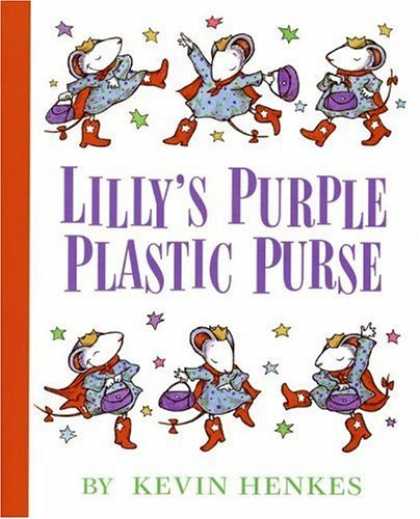
Lilly's Purple Plastic Purse


Lilly's Purple Plastic Purse is written and illustrated by Kevin Henkes. This story is about Lilly and her experience at school with her teacher, Mr. Slinger. Lilly loves her teacher Mr. Slinger and he makes her want to be a teacher. However, one day, Lilly brings her new movie star sunglasses, three quarters, and most importantly, her new purple plastic purse to school. She's so excited about her new stuff and she cannot wait to show Mr. Slinger and her classmates. Everytime she tries to show her new stuff off she is a distraction and Mr. Slinger has to tell her no and remind her to stop distracting the class. He even takes her things to hold on to them until the end of the day. Lilly is so upset that she writes a mean letter to Mr. Slinger and says she does not want to be a teacher anymore. As Lilly is walking home from school she looks into her purse and sees that Mr. Slinger has written her a nice note and put the snack she refused to eat inside. Lilly then feels awful. So she writes an apology note and drawing for Mr. Slinger and her mom makes snacks for Mr. Slinger. The next day at school she apologizes and says she does want to be a teacher again. Mr. Slinger is so happy.

I love this story. Lilly is such an interesting main character - she's so quirky and funny. This story is interesting because this could be a real life situation with a teacher and it teaches readers a very important lesson. I also liked how this story was all about school making it a perfect book to read in a classroom. I always love Kevin Henkes drawings. They're so detailed and have their own style to them. I would definitely read this book to my students. In fact, I bought the Kevin Henke collection from the scholastic book order so that I could have these books to read in my own classroom during read-aloud and for my classroom library collection. Kevin Henke is a terrific children's book author.

A Dark Dark Tale


A Dark Dark Tale is written and illustrated by Ruth Brown. This book follows a spooky black cat and takes us from a dark, dark moor, through the dark, dark woods, to a dark, dark house, etc. Eventually we're led to a dark, dark cupboard where there is a dark, dark box in a dark, dark corner. When we finally see what is in the dark, dark box we discover a MOUSE! The mouse is curled up in bed living in this little box. This book builds suspense as you wonder where the black cat is leading us.

This book is a great spooky tale. It would be fun to read to younger students to build really spooky suspense. The kids would enjoy the repetition of "dark, dark" and would probably find it funny that we end up finding a mouse and not something scarier. This book would likely be a book where the kids easily learn the words and could say it all together in unison. It would also be fun to read in spooky voices. This book would be perfect to read as a Halloween tale and it would also be a book students could learn and act out if we had a drama unit. I enjoyed this book but it is very simple - I think it would bore older kids.

The illustrations are great - they are painted and perfectly set the haunting mood of the story. The paintings capture light streaming in through the windows or through clouds. I loved the way light was portrayed in the images. I also liked that there was a black cat we could follow and find on every page. Overall, the illustrations were ideal for this story. I would read this book in my classroom.

Friday, March 26, 2010

Owen


Owen is written and illustrated by Kevin Henkes - one of my favorite children's authors. Owen received a Caldecott Honor and is an "absolutely wonderful, positively perfect, especially terrific" children's book. This book is about a little mouse named Owen who is soon to be starting kindergarten. Owen carries around a yellow security blanket that he has named "Fuzzy". This blanket does everything that Owen does and likes everything that Owen likes. It gets ratty and dirty and Owen's parents begin to worry that Owen is getting too old for a security blanket and that he may try and bring it with him to school. Therefore, Owen's parents decide that they will try and convince Owen to stop taking Fuzzy with him everywhere. They try to make him put it under his pillow for the Blanket Fairy to take it and leave a present but that doesn't work. They try to make it smell bad by dipping a corner of it in vinegar but that doesn't work either. Finally, Owen's parents decide to cut it up into tiny hankerchief-sized pieces so Owen can keep taking small parts of Fuzzy with him rather than the entire blanket.

Henke's books are always a pleasure to read. I have read many of his other books, but I had never read "Owen". I really enjoyed reading it. I even found myself curious about what his parents were going to do about his security blanket. There was a little suspense in the story, it was well written and of course, the illustrations are always wonderful to look at.

I liked how the book dealt with real-life issues and that solutions were attempted - this book serves as a positive message for kids but also as a suggestion book for parents on how you can get your child to get rid of their security blanket. I love Henke's books and will read his stories to my classes and my own children in the future.

The Berenstain Bears and the Slumber Party


The Berenstain Bears and the Slumber Party is written and illustrated by Stan and Jan Berenstain. This book is just one of a large series of Berenstain Bear books and all of them are visually interesting, have a strong message and are enjoyable. In The Slumber Party sister Bear is invited to a slumber party at her friend's house. Mama and Papa Bear are uneasy about allowing her to attend her first slumber party - especially Mama Bear. However, after a talk about privilege and responsibility, Mama bear decides to let sister bear attend. This slumber party becomes much more than a slumber party. It turns out that sister bear's friend's parents are not home and that sister's friend invites almost all of the cubs in the neighborhood! This slumber party is really just a party and the cubs play music loudly, dance, and make a big mess! The police are called and sister's friend's parents come home early to discover what has happened. All of the cubs are picked up by their mama's and papa's and sister bear gets into a LOT of trouble. Mama bear is very disappointed that sister bear ignored their discussion about privilege and responsibility. In the end, however, after sister bear is sent to her room, mama and papa bear come to the realization that sister bear played a role in the party but that it was one of those things where one thing led to another and got out of control. Additionally, papa bear points out that he and mama bear should've called the Bruin's to check if they were home so they are partially to blame as well. Mama bear agrees so she decides not to ground sister bear and instead takes her to the Bruin's home in the morning to help clean up the mess from the party.

I love the illustrations in the Berenstain Bears books. These books have been favorites of mine since I was young and I remember being captivated by the creative illustrations (especially of the tree houses!) and loving the characters and story. These books are loved by children because of these things. I also like how each story gets a message across and opens the door for parent-child conversation. After reading the book, it would be smart to discuss the book and to ask why what happened happened and what the bears may have done differently, etc. These books address very prevalent and important topics that come up in real life. Having the main characters be bears makes the story more entertaining for children and keeps them engaged with the story. I would definitely read these books in my own classroom for read-aloud OR keep them in my classroom library for students to read. The Berenstain Bears books are classics loved by all.

Thursday, March 25, 2010

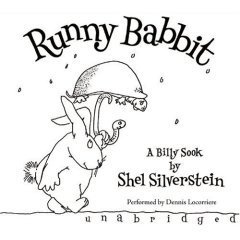
Runny Babbit


Runny Babbit is "a billy book by Shel Silverstein". This is a picture book, rather than Silverstein's common poetry writing. This book is about a little bunny rabbit (or "runny babbit" who speaks a rabbit language that flip flops the first letters of two words around. The book is difficult to read due to all the flipped and flopped words!

We follow the runny babbit around for all of his life events - he's a baby and you meet his family, he learns to eat by himself, he needs to clean his room, he meets a lady porcupine and has his first kiss, he gives himself a terrible haircut, he gets into trouble, he gets sick, he reads books (or beads hooks), he gets a girlfriend, he gets a baby, and he learns to love himself. Each page is like a chapter of the runny babbit's life and each page has words that are switched around making it funny to read aloud! One of my favorite pages reads,

Kugs and Hisses

Runny said, "I'm lonesome,
I feel so glad and soomy.
I need some kugs and hisses-
Now, who's gonna give 'em to me?"
"I will," said Polly Dorkupine,
"'Cause you're as cute as a rug in a bug."
Said Runny, "Well, I'll kake the tiss,
But never hind the mug."

Silverstein's idea is so creative and fun! I loved solving each page and figuring out what each line really was trying to say. This book may be for somewhat older children given the complexity of the way the words were written. It took a while to read each page, but overall is was fun, the illustrations were SIlverstein classics and I enjoyed it! It was not like his other work, which was exciting to read.

Don't Bump the Glump and Other Fantasies


Don't Bump the Glump is written and illustrated by Shel Silverstein. This book was Silverstein's first poetry collection he ever wrote and it was first published in 1964 around the same time as The Giving Tree. Both this poetry Collection and The Giving Tree were illustrated in color - the only two books Silverstein published in color throughout his career.

This book is about the many fictionalized creatures and their strange names. It reminded me of Dr. Suess characters with silly names like the Wild Gazite, The Galloping Griss, The Terrible Feezus, The Gletcher and the The Furless Flatchim to name a few! A short poem is written next to each creature on each page and they all rhyme and have a nice rhythm to them. For example, in the poem, "The Underslung Zath",

I fear the wrath
of the Underslung Zath
Will someone else tell him
It's time for his bath?

There are many others such as "The Crawfee":

That silly fish, the Crawfee,
Has been swimming in my coffee.
But now I've drunk it up
And he isn't in my cup. And he's nowhere to be found...Do you think that he has drowned?

Each short poem is silly and imaginative. I can see from this poetry collection how Silverstein's work progressed - his poem writing developed his own style. This book is fun, but no where near as fantastic as his other poetry collections. This book was a great start for a poet's first work but I like the original style Silverstein's poetry takes on later in his career.

Wednesday, March 24, 2010

Where the Sidewalk Ends


Where the Sidewalk Ends is written and illustrated by Shel Silverstein - my favorite children's poet. Where the Sidewalk Ends is the third poetry book of the three book series by Silverstein. Yet again, this book brings a lot to the table. All of the poetry books bring readers into Silverstein's crazy, creative, imaginative, ridiculous world and it's such a fun ride! The cover of this book is by far my favorite - it's such an awesome thought -the sidewalk ends and it hangs over this endless abyss. I love the children peering over the edge and the dog holding on for dear life - his illustrations really create such a different world for being so simple.

One of my favorite poems is, "Sarah Cynthia Sylvia Stout Would Not Take the Garbage Out". My favorite verse is:

And so it piled up to the ceilings:
Coffee grounds, potato peelings,
Brown bananas, rotten peas,
Chunks of sour cottage cheese.
It filled the can, it covered the floor,
It cracked the window and blocked the door.

This poem about how a little girl refuses to take the garbage out sends a clear message to kids - you better take the garbage out or else it will tower so high and collapse on you! It was just funny, had great rhymes and all of the food descriptions were so detailed.

Another poem I loved because of the simplicity is "Fish?"

The little fish eats the tiny fish,
The big fish eats the little fish -
So only the biggest fish get fat.
Do you know any folks like that?

His poems are just wonderfully imaginative and so much fun to read. I genuinely look forward to reading them in my own classroom in the future.