Wednesday, February 10, 2010

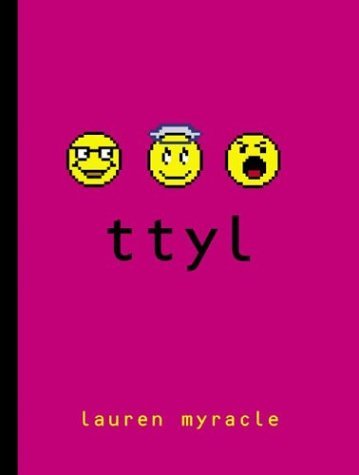
ttyl


This piece of fiction was written by Lauren Myracle. This book creatively documents the lives of three tenth grade girls - Zoe (zoegirl), Maddie (mad maddie), and Angela (SnowAngel) through instant messages. This book is definitely for older kids - middle school aged and older. These three best friends experience the ups and downs of high school - boy drama, academic troubles, cliches, teacher issues, etc.

What was the most fascinating about this book is how it is formatted. The text messages provide a creative, yet realistic writing style. Instant messaging was big when I was in high school so I found it fun to be back in that "world" and it made for a quick read. I also liked getting to know the main characters through their instant messages - it was great that I could actually feel connected to characters and get to know them given the format.

This book touched on some tough topics that were risky to discuss - the biggest being the flirtation between Zoe and her teacher. However, this topic is addressed as inappropriate and Zoe's friends make that clear. On page 188, Zoe and Angela are discussing this situation.

zoegirl: it's my fault for going to backwork all those times. i gave him the wrong idea.
SnowAngel: u don't seriously believe that, do u?
zoegirl: kinda
SnowAngel: first of all, u didn't give him the "wrong" idea, cuz up til now u've totally been crushing on him and u know it.
zoegirl: i know, which is why i feel so bad.
SnowAngel: but second of all, HE'S the grown-up. if it's anybody's fault, it's his.

This part of their conversation shed a light on the seriousness of this flirtation.

Overall, this book was fun and girls in this time of their life would relate and enjoy this book, but it would not be appropriate for elementary-aged children.

Monday, February 8, 2010

Tio Armando


This children's book is written by Florence Parry Heide and Roxanne Heide Pierce. It is illustrated by Ann Grifalconi. The main character, Lucitita, is a young girl whose Mexican-American family welcomes their great uncle into their home after his wife dies. Tio Armando, as they call their uncle, is Lucitita's favorite person in the world. She makes snowmen with him out of marshmallows and visits the hospital with him to give gifts to patients they don't know as a surprise. Tio Armando always provides the children with a lot of wisdom but everything changes when Tio Armando dies. Lucitita is very heart-broken and has to face the death of such a close loved one. But Lucitita now knows what Tio Armando had always been trying to teach her - that even though her Tio is dead, that he will always be with her and will never be gone. Lucitita also wants to carry on with the good that Tio Armando did.

This story is for kids in first grade up to third or fourth. This story is organized into months - the months that Tio Armando spends with the family. Each page has a fair amount of writing on it, so very young children would likely lose interest. The illustrations are done in watercolors and are very soft with warm colors. I think they're beautifully painted, but some kids may not find them vivid enough to hold their attention for the quantity of writing on each page.

The story covers very relevant topics to children today. This story covers a Mexican-American family dealing with death. Death is a difficult concept to grasp for young children and this book is very brave to take on such a topic and explain a child's grieving process. Any child who has experienced loss or who is curious about it would find this story relatable or engaging.

Grandfather Counts


This children's book is written by Andrea Cheng and illustrated by Ange Zhang. This story follows an Chinese-American family and their welcoming of their grandfather "Gong Gong" into their home to live with them. The main character Helen, a young girl, is nervous to see her grandfather again who speaks no English - she wonders how they will communicate. At first Gong Gong keeps to himself until one day Helen is sitting behind their house watching the train go by when Gong Gong decides to join her. Gong Gong and Helen begin to teach one another their native languages by counting in Chinese and English and they begin to form a special bond, breaking through the barriers of language.

This story would be good for kids ages 4 - 8. The story is written in a very clear way but also contains different languages, which may make the story slightly more difficult for younger children. Additionally, the story is very simple with a very undramatic climax. It may keep some children's attention, but they'd really have to be interested in the subject matter or find the material relatable to truly enjoy the story.

The subject matter could be very relatable to children who come from mixed race, bilingual families and for children who have grandparents who come to live with them. These family issues could make the book very interesting to many students.

The illustrations appear to be painted and they are detailed yet soft. Each picture tells the story and will captivate young children and likely keep them engaged.

New Shoes, Red Shoes


This children's book was written and illustrated by Susan Rollings. This book tells the story of a little girl going on a shopping trip to get new shoes with her mother. After she picks out her new, shiny, red shoes she goes to a birthday party and loves her shoes best of all!

This story reads with a nice rhythm and is a great book for beginner readers in preschool - kindergarten. Although the story seems materialistic because it focuses on shoes (of all colors and sizes!) the story contains more than it's few words describe. There are subjects hidden beneath the words that may be controversial yet relatable. Firstly, the story only follows a mother and her daughter. There is no male figure in the story. Secondly, the mother and daughter take public transportation to go on their shopping trip which could indicate that they are of low socioeconomic status or they just are living green and trying to better the environment. These factors could make the book more realistic and relatable to some students.

The illustrations are painted and very colorful. They're simplistic yet portray emotion and capture kids attention. They contain a lot of details despite their simplicity. The main character is a little girl who seems to be the same age as the students who may read this book.

The content is relatable, simple and can be read with a smooth rhythm. Most young children would enjoy this simple story.

Sunday, February 7, 2010

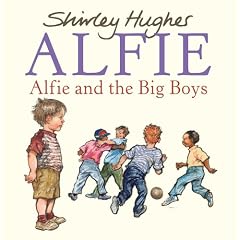
Alfie and the Big Boys


This children's book is written and illustrated by Shirley Hughes. There are many Alfie books in a series that Hughes has written. This particular story follows Alfie in Nursery School. Alfie always watches the kids in primary school through the fence while he is playing outside. One boy in particular - Ian - captivates Alfie and he wishes he could be just like him. One day while out with his mother and baby sister, Alfie sees Ian at the playground. Ian is screaming and crying for his "mum" whom he thought he lost. Alfie comforts the older child until they find his mother. After this incident, Alfie realizes that he is a pretty big boy himself. Later Ian comes to his house with his mother for tea and they all play together nicely.

This book is intended for children in preschool or early elementary school. The illustrations are very captivating - detailed and very well done. The book was clearly written by a British author as many of the words were not as familiar as American english words. The book contains a positive lesson about growing up and is very easy to read.

I'm not sure if all children would enjoy this book. There isn't really a climax as not too much happens. Additionally, some of the language would not be understandable to children here in the United States. Although the story was a bit slow, I still enjoyed reading it and think some kids would find it interesting - particularly the illustrations. I'm surprised this book is one of a series as Alfie's character wasn't really developed, but I have yet to read the other books in the series so I'll have to save my judgment until then.

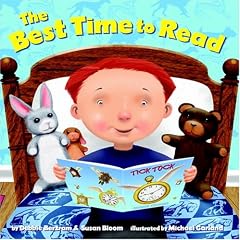
The Best Time to Read


This book is co-written by authors Debbie Bertram and Susan Bloom and illustrated by Michael Garland. This book tells the simple story in first person of a young boy who has just learned how to read. He is excited to share his new reading ability with his family! He tries to read to his mother and father but they're too busy. He tries to read to his sisters and his brother but they're too busy too! He tries to read to his grandma and grandpa, but they are also too busy to listen. Lastly, he tries to read to his dog, who also refuses to listen. Hurt, the little boy retires to his bedroom where he begins to read to his stuffed animals. As he is reading his entire family comes into his room finally able to listen to him read a story.

This book is great for kids in Kindergarten through to second grade because these are the ages where kids are learning how to read or working on reading more proficiently. This story is very relatable to kids because they've probably often wanted to read to a family member but have been unable to given how buys everyone is. Or kids know what it's like to want something to happen, but become frustrated when no one has time for you. This book is easy to read and rhymes, which makes it fun. The story is simple, yet encouraging.

The illustrations in this picture book are very cool and unique. They look digital, but I am unsure. They are very modern and look like graphics in a pixar movie. Each page is filled with details and things to look at and the pictures are very colorful.

Monday, February 1, 2010

DIARY of a Wimpy Kid


This children's chapter book is written and illustrated by Jeff Kinney. The "DIARY of a Wimpy Kid" series has become rapidly popular and even made The #1 New York Times Bestseller list. The series consists of 4 books currently, with a 5th book coming out this year in 2010. The book I read is the first of the series. This story follows Greg Heffley and his adventures in Middle School - a period of three years I think most of us would love to forget. Greg journals all about his life - his school life, home life and social life. He writes just as a Middle School student would write and he touches on topics that most of us dealt with during that period of our life - bullies, homework, getting into trouble, rules, sibling rivalry, friendship, crushes, embarrassment, etc. This story follows one school year from start to finish and follows the ups and downs of Greg's life.

I think this book is great because of how relatable it is to kids. Greg is dealing with exactly what they are and Greg shares a lot of similar opinions and thoughts with Middle School aged kids. The formatting is easy to follow and comprehend. Each page looks like the lined paper of a notebook and greg draws a picture of what he writes about on almost every page. The writing is full of humor and makes for a quick read. Students I have worked with in the schools or who I've babysat for, all rave about this book. Because these books came out well past my Middle School years, I thought I definitely needed to find out what I was missing and see if all of these kids are right and they are - it was enjoyable to read and really funny!

I do see a few things with this book that could cause some concern to certain people. For one, this book is about a pre-teen and that means he's thinking about girls and goofing off in school and not doing his homework. This book documents the irresponsibility and immaturity a lot of Middle School boys exhibit during this period of their lives. Some parents and teachers may find that this material only encourages such behavior (ie. talking back to teachers/parents, taking advantage of friends, caring obsessively about popularity, etc.). However, these things happened before this book came out too. Whether this book is out there or not, Middle School kids will continue with some of that behavior. The positive thing about this is that kids will realize they're not alone and that most kids feel this way. Additionally, Greg usually faces the negative outcomes of what his poor choices bring him.

One thing that does concern me is the age level that should read this book. I think fourth grade me even be a little young for this book, but this book is somewhat inappropriate for third grade students and below. This book is certainly appropriate for fifth graders and students in Middle School, but if this book were in an Elementary School library, kids much younger could get their hands on it.

Overall, this book was well-written, an entertaining read, funny and was written in an interesting format. I really enjoyed it and can see why kids do too. I may just have to check out the other books in the series, as well...

http://www.wimpykid.com/

Sunday, January 31, 2010

A Giraffe and a Half


This children's book is written and illustrated by one of my favorite children's author - Shel Silverstein. This story is about a little boy who stretches a giraffe's neck to make a giraffe and a half. After the giraffe stretches, the giraffe proceeds to get himself into all sorts of trouble as all different things and creatures get stuck on him. All of these things keep collecting on this giraffe until he has so much on him - for example, a rat in a hat on his head, wearing a suit, a rose glued to his nose, a bee on his knee, a shoe stuck with glue, and a chair on his hair, etc. The story ends with the giraffe ridding himself of all of these crazy things until finally he shrinks back to his normal size and we're left with a giraffe.

This story would likely be enjoyable to many kids. It is hilarious as the giraffe puts himself into weirder and weirder situations and everything he steps in or puts on rhymes. The book is read with sequence as each thing he puts on continues to be read on the following pages with one more new thing added. Then eventually all of the things are dropping away until we're back with just a giraffe, as there was on the very first page. This story would be helpful for kids learning to rhyme and is entertaining due to the humorous writing and the hilarious illustrations.

As always, Shel Silverstein's illustrations are simple and contain no color. They have such a unique style that they always work for Silverstein's stories. Color would be fun, but I believe it is not necessary. The story is read with a great rhythm and would be very fun to read to kids!

Nubs - The True Story of a Mutt, a Marine & a Miracle


This book is a true story (with real photos from the events) written and collaborated by Major Brian Dennis, Kirby Larson and Mary Nethery. This story has become well-known world wide. It was featured on various news channels and was written about in an article in People Magazine.

This story is about Nubs, an Iraqi dog of War, who forms a special bond with an American Marine - Major Brian Dennis. The two carry on a friendship and become very attached to one another - Nubs follows Brian around and waits for him when he goes away. Brian cares for the dog by giving him food, shelter and even medical attention. However, one day duty calls and Brian is forced to relocate 70 miles away and he's not allowed to bring Nubs with him. But then Nubs does the unthinkable - he follows Brian's humvee on it's trek across the desert without food or water! Brian is astonished and knows that Nubs is a very special dog so he decides, after a long process of paperwork and other precautions, to send Nubs to America to wait for him and be his dog when he returns from Iraq. This story of unlikely friendship and love is a heart-warming story that has touched many hearts.

This book is very colorful and the pictures capture each moment in the story. It is engaging to look at and if children like dogs, they will likely enjoy this story. Additionally, any child who has a father, brother or other family or friend fighting right now overseas will likely find this story interesting and memorable. I also think this story will appeal to both boys and girls because of it's content, the pictures and it's focus on a dog.

I think the writing was as kid friendly as the story could be. There were a lot details about life as a soldier and with paperwork to get the dog back safely that could have bored children, but I think that information was reduced substantially in a way that was understandable for young kids.

As an adult, this story fascinates me. I would be very interested to find out if kids like this story as well or if some of the amazing aspects of it go over their heads. Would be a great book to try out with kids of all ages!

The Horrible Spookhouse

This book was written by Kicki Stridh and was illustrated by Eva Eriksson. This story is about a little girl who gets lost in the woods and who cannot find her mother and father. As night nears, the little girl knows she must find somewhere to sleep. She's also terribly hungry. She approaches a terrible spookhouse in the woods filled with ghosts, goblins, witches, monsters and lions! But the little girl is not afraid. She's not afraid of the witches or their brew, of the lion's terrible roar, of the monster grabbing her, of the witches in her bedroom or even of a room full or scary creatures and goblins! All of the inhabitants of the spookhouse are puzzled and confused because the little girl is not scared by them. They let her leave in the morning and she finally finds her mother and father again and she is always talked about in the spookhouse as the little girl who could never be scared.

I had never read this story before so I had no preconceived judgments ahead of time. I liked the story because it provided a lot of suspense. If I had read this book aloud to students I could have come up with a lot of interactive questions that would engage students and get them thinking. There were many times I could've asked what they think was going to happen next or many times I could have asked them what they saw on the page or why the little girl was acting the way she did and whether they would've acted the same way or not. It's a positive thing to get kids talking and questioning while reading a story to keep them on their toys and excited to get to the next page.

The story was very predictable, but it may not be for a small child. Additionally, the illustrations were creative and very different, but not my favorite style of illustrations - they didn't really catch my eye as some illustrations in other books have done. The writing was also a bit long on certain pages when there wasn't much to look at illustration-wise. This would be problematic for young children, but probably okay for older children.

All in all, it was a nice story that would be very interactive if read to children and that makes it a successful book, in my opinion.